

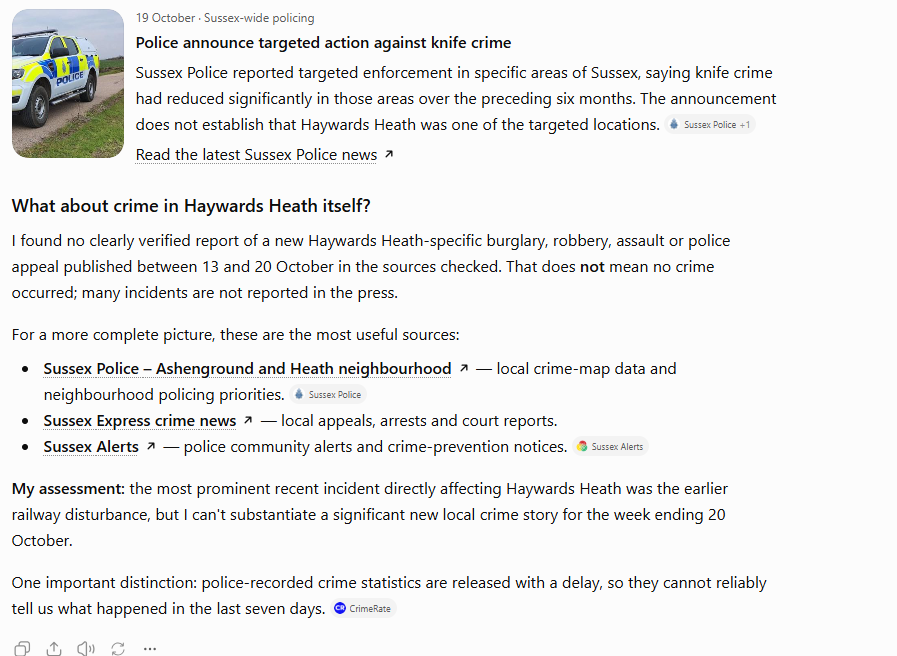
Research has shown that popular AI chatbots such as ChatGPT and Google Gemini often ignore local publishers, even on queries about local issues such as council decisions and crime.
The research by AI search visibility specialists Searchable found that ChatGPT cites national newspapers (18.8%) almost as much as local ones (21.2%), even on a local query.
ChatGPT also tends to prioritise online updates direct from local councils, as opposed to reporting on them – going to council or government sources for 81.3% of questions, and local news sources for just 0.9%.
Out of the top 20 news sources cited by ChatGPT for local queries, for example, there is only one local news title, Wales Online, which is in 18th place ranking behind multiple national titles, Wikipedia and Facebook.
Up to 10% of news-related prompting is for local news issues, the research found.
The research comes as Ofcom’s latest 2026 News Report revealed that one in five people in the UK now use AI apps as a source of news, with AI use for news most prevalent among 25 to 34-year-olds (37%).
The Searchable researchers used 30,000 prompts, asking 20 unique questions about 100 UK towns and cities to five different AI assistants: ChatGPT, Perplexity, Google Gemini, along with Google’s AI Mode search, and AI Overviews (which appear at the top of Google searches).
Queries covered subjects such as where to find local news, crime, planning, housing, roads, council decisions, sport and local events
The 244,725 citations across five AI chatbots drew on 10,000 unique websites.
On crime queries, police force websites supplied 57.8% of the answers and appeared in 95.9% of them.
The research focused on both established local newspapers and on less established news sites that post local news regularly.
Chris Donnelly, Searchable CEO, explained how ChatGPT actually searches for news (a more detailed version is available here).
Donnelly said: “When you ask ChatGPT what is happening in your local town or city, the AI chatbot breaks the question down into several searches behind the scenes. It then builds its answer from the pages that surface in those searches. This is what shows us at an early stage of querying, the kind of competition local news sites face in AI systems.”
On average, the searches brought back information from 12.3 websites, using information from four in the reply.
Donnelly said: “At the moment, one in seven of those searches points to a local news provider, on average, while one in three is aimed at the council, the police or another official body.
“In most ChatGPT answers to local news queries, a publication covering that story regularly competes with up to 16 other pages to be a source, and that’s not including competitor news sites.
“Do local publishers need to worry? On the one hand, figures from Chartbeat, published by the Reuters Institute, show that Google search traffic to publishers fell by a third in 2025, as AI-generated answers rolled out further. On the other hand, referrals from AI tools to news websites grew 770% in the year to June 2025, according to a report on Similarweb‘s data. However, that growth referred to large global newsbrands, and Google search still sends far more visits to websites than AI platforms.
“For a regional title, AI is not yet making up for the search traffic publishers are losing, which makes the audience it builds on its own patch matter even more important.”
Donnelly said the findings show that focusing on local search queries could offer a way forward for publishers.
He said: “If local publishers are serious about increasing their AI visibility for local queries, it’s worth noting how specific ChatGPT’s searches are when looking for answers. They can narrow down as granularly as a named road or even a planning application number, putting the onus on local titles to cover more of these issues.
“And these are the same topics that Newsquest praised last year for helping to keep its most loyal readers coming back during a notable period of subscriber growth. For a local title seeking to appear more often in AI-generated answers, the case for covering what is happening in their area, rather than chasing nationally trending stories, seems stronger than it was in the era of traditional Google search.”
Email pged@pressgazette.co.uk to point out mistakes, provide story tips or send in a letter for publication on our "Letters Page" blog
